
- Benchmark test
- CPU test
Benchmark your CPU
Novabench runs workloads that reflect realistic usage patterns and indicates issues that may be limiting performance.
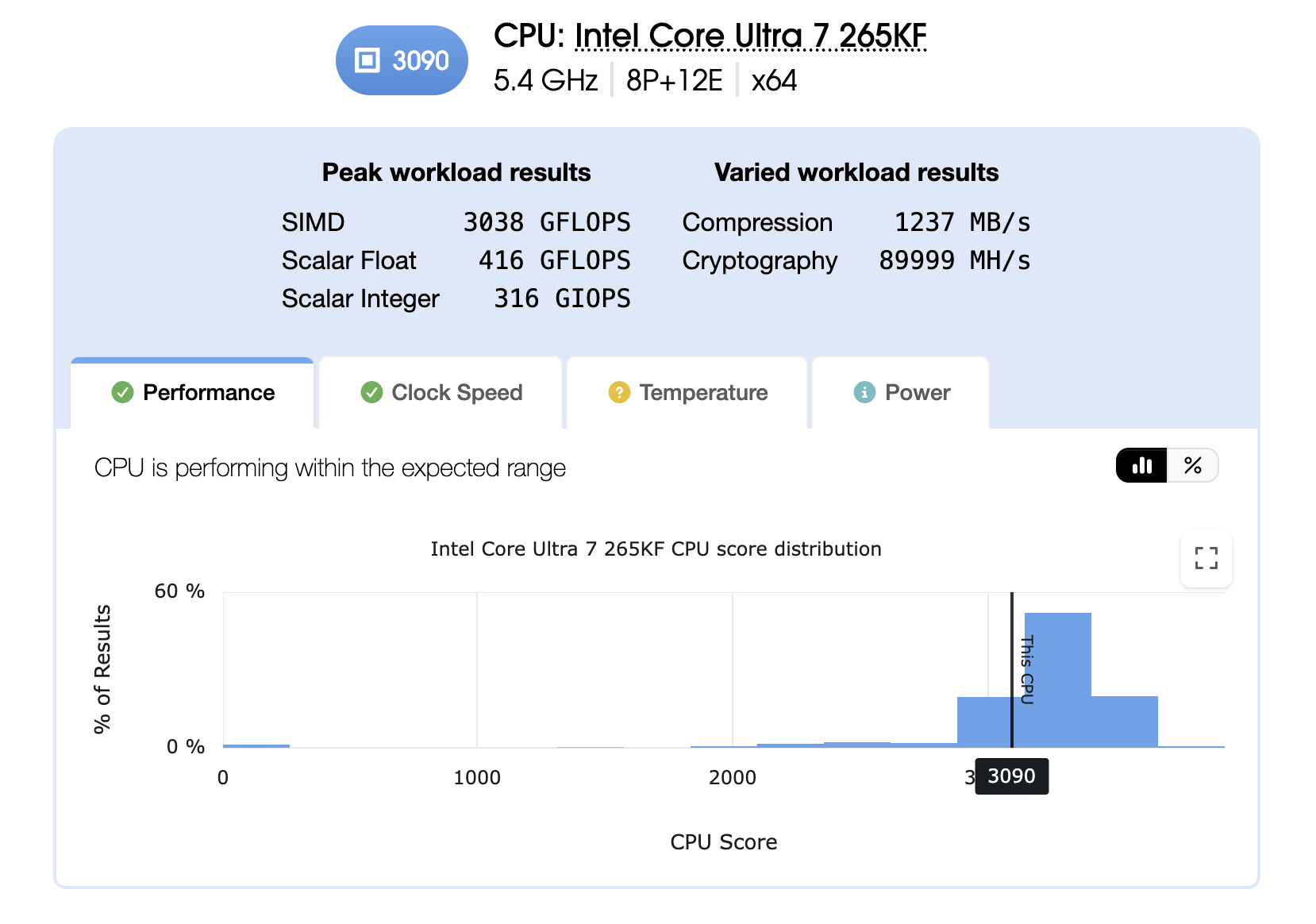
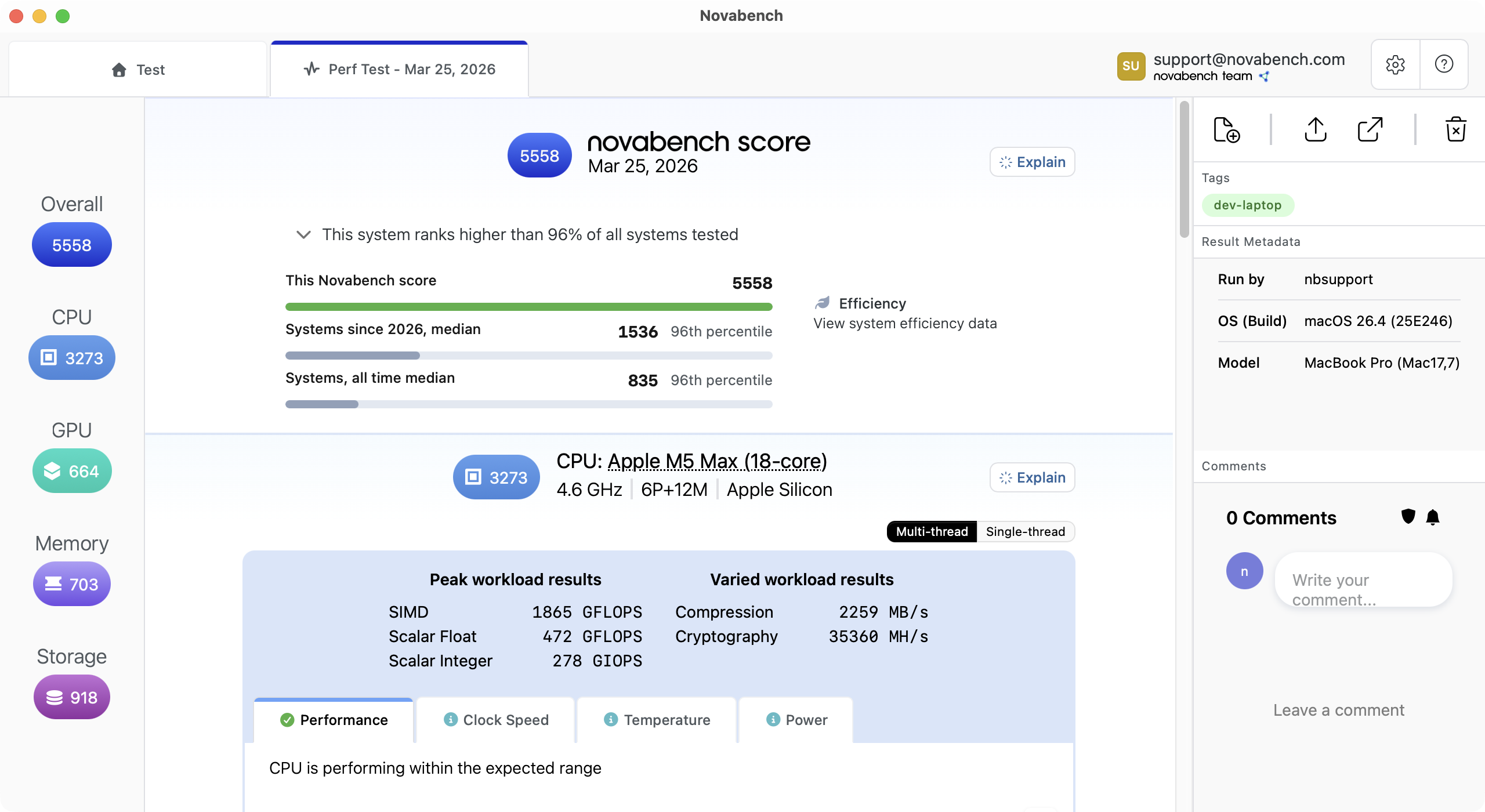
What the CPU test measures
Novabench runs five workload types across single-core and multi-core modes. Individual test results roll up to top-level scores that reflect a balanced performance profile for general comparison.
- Scalar integer and floating-point math for general-purpose throughput
- SIMD vector workloads for peak GFLOPS
- Workloads with varied memory access, including compression and hashing
Compare across Windows, macOS, and Linux
Novabench CPU workloads are comparable across supported platforms and architectures
How the CPU benchmark works
Novabench's CPU benchmark is designed around three priorities: consistent measurement, fair comparison across systems, and a balanced top-level score backed by full per-test detail.
- Warmup and calibration
- Each test starts with a warmup phase that brings the CPU to a steady operating state and calibrates workload size to the system, so a fast chip and a slow chip both run a meaningful amount of work.
- Process isolation
- Each test runs in its own worker process, separate from the Novabench app. This lets the benchmark control exactly how the workload runs on the CPU, without interference from the app's own UI, logging, and sensor sampling. It also keeps each test from being influenced by the one before it.
- Thermal gaps between tests
- A brief cooldown between tests lets the CPU recover, to reduce the thermal impact of prior tests on later ones.
- Cross-platform test equivalence
- The computational work is the same on Windows, macOS, and Linux, and across x64 and ARM64. Where platform differences make exact equivalence impossible, tests are designed to be functionally equivalent so scores compare cleanly across operating systems.
- Workloads and scoring
- Five workload types feed a geometric mean to produce the CPU score. The headline score is a summary for general-purpose comparison; the per-test details show how a CPU handles specific workloads, and both are always shown together.
- Hardware detection and CPU topology
- Every result captures CPU model, frequency, core count and topology, and virtual machine status. That means when you compare your score to others, you're comparing against the same chip in the same configuration.
- Multi-iteration runs for precision
- Novabench's default run time is a balance between speed and precision. You can also enable multiple iterations where each workload runs several times and results are aggregated, trading test time for lower variance.
Frequently asked questions
Yes. Novabench Free runs the full CPU benchmark along with GPU, memory, storage, and NPU tests on Windows, macOS, and Linux. Paid tiers add sensor monitoring, deeper reports, and team features.
Benchmark your CPU
Download Novabench free and score your CPU in minutes on Windows, macOS, or Linux.